

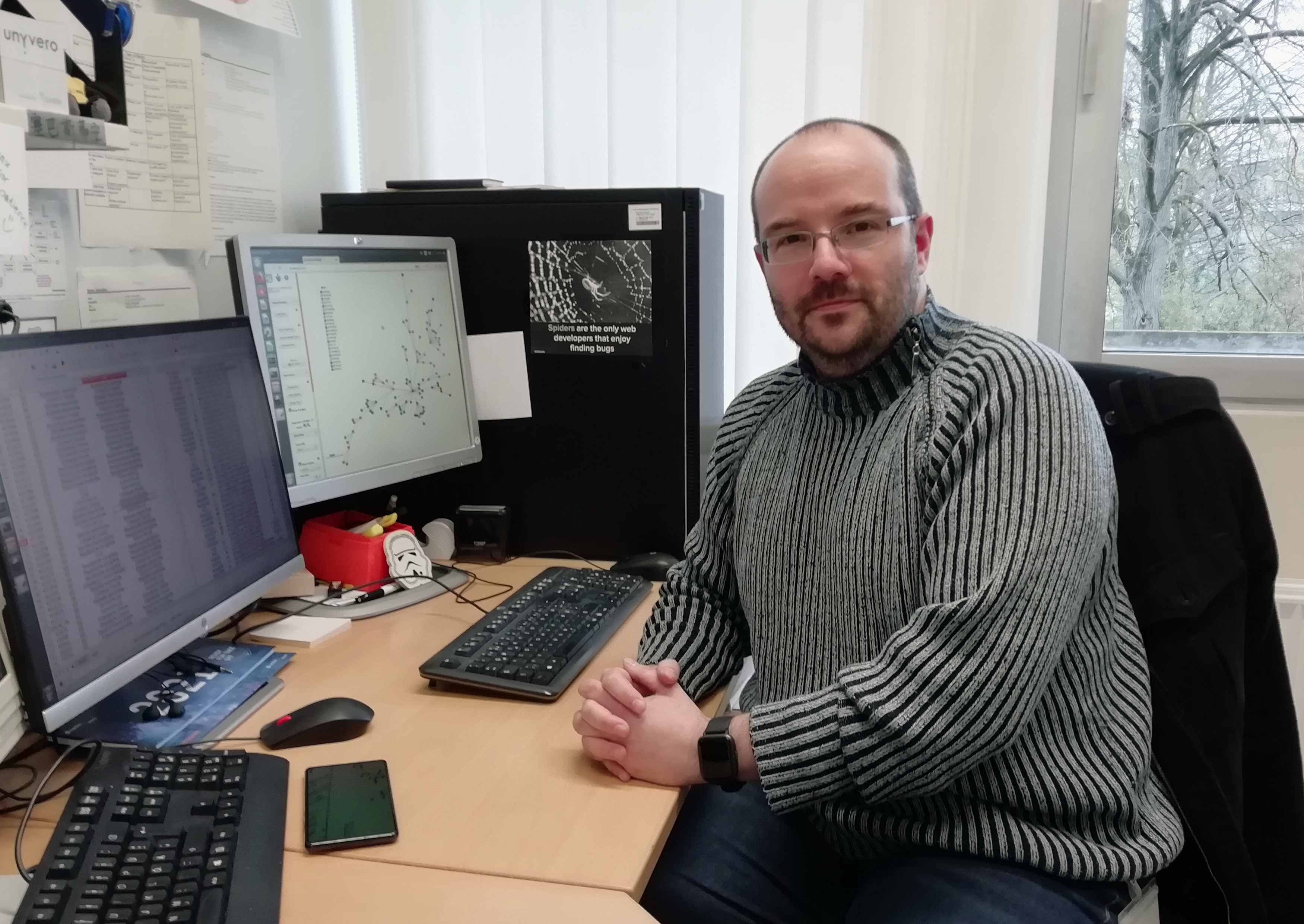
Uncovering the secrets of the lung microbiome – An interview with DZL - Junior Group leader Dr. Sébastien Boutin
We interviewed Dr. Sébastien Boutin on the lung microbiome, his ongoing lung research projects and how research on the microbiome can be translated into therapies for patients.
Since 2020, Sébastien Boutin has been head of the DZL junior research group "Lung Microbiome" at the Center for Translational Lung Research in Heidelberg (TLRC). His team of three investigates associations between the airway microbiome and the expression of chronic lung diseases such as cystic fibrosis (CF), chronic obstructive pulmonary disease (COPD) and idiopathic pulmonary fibrosis (IPF). The group specializes in NGS sequencing techniques and bioinformatics analysis, and offers these as a service to collaborating DZL scientists.
What bacteria are typically found in the lungs?
Compared to the gut microbiome, we find relatively few different species inside the lungs, about 100. Surprisingly, they are mainly anaerobic bacteria, i.e., those that manage without oxygen. This is because there is little or no oxygen in deeper layers of the mucus of the lungs. Mostly, we find bacteria of the genera Streptococcus, Prevotella, Veillonella and Neisseria.
When does a person's lung microbiome develop?
The first bacteria enter the respiratory tract in the womb via the amniotic fluid. After birth and throughout the rest of our lives, the composition of the lung microbiome is constantly changing - so compared to the gut microbiome, it is much more dynamic. With every breath, new microorganisms enter our lungs and the lungs are constantly eliminating bacteria, e.g. through so-called mucociliary clearance - the self-cleaning mechanisms of the bronchi.
Can we influence the composition of our own lung microbiome?
Lifestyle and diet strongly influence the lung microbiome. Smoking, for example, reduces the diversity of the bacteria inside the lungs, as does the use of antibiotics. The link with diet is explained by the fact that bacteria from the mouth can enter the lungs. We have demonstrated that the lung microbiome of people with caries, or treated caries, is different from those who have never had caries. The caries-causing bacteria seem to displace other harmless bacteria, and that has an indirect effect on the lung microbiome.
Is there a link between oral health and lung disease?
That is the subject of our current research. For example, in one of our projects with the Thoraxklinik, we are investigating whether there is a link between periodontal disease and COPD, and whether treatment of periodontal disease has an impact on exacerbations and the lung microbiome. We have a lot of DZL projects that relate to the entire respiratory tract - so nose, throat, and oral cavity - because all of them are connected to the lungs.
What are your current research priorities?
Our biggest project is a study investigating the relationship between the lung microbiome and the severity of cystic fibrosis over a long period of time. Since 2013, we have collected and analyzed samples, e.g. sputum or nasal and tracheal swabs from patients at different time points. This way, we are able to track the evolution of patients' respiratory microbiome over several years and correlate it with their symptoms.
What did you find out about the link between cystic fibrosis (CF) and the microbiome?
From birth the lung microbiome of patients with CF is less diverse than that of healthy individuals, even if the bacterial signature is very similar. However, upon an infection with pathogens, e.g. Pseudomonas, the CF microbiome becomes less dynamic and the infectious bacterium dominates. Even the introduction of bacteria from outside does not change this effect. We have also found that there is a correlation between the decrease in lung function, the severity of inflammation, and a decrease in the diversity of the lung microbiome. We're trying to figure out if you can reverse that effect, but it's hard to treat a Pseudomonas infection.
How could microbiome research improve the treatment of cystic fibrosis?
The most effective way would be to find ways to prevent infections, for example by manipulating the respiratory microbiome through pre- or probiotics or by influencing the microbiome indirectly by changing the lifestyle. One day it might also be possible to use phages to target bacteria such as Pseudomonas. We are also planning to use metagenomics and metatranscriptomics analyses to find out which resistance genes are present in bacteria inside the lungs of a patient. This knowledge would help to choose the right antibiotic treatment.
What are the main research areas you would like to focus on in the future?
We plan to conduct longitudinal studies to track the evolution of the lung microbiome in other chronic lung diseases, such as COPD and asthma. We would also like to increase our use of new sequencing and analysis methods to study the lung microbiome. So far, we have focused on studying bacteria using 16S sequencing. In the future, we would also like to investigate the presence of viruses and fungi using metagenomic analysis methods.
Where will lung microbiome research go in the future?
While we know that the lung microbiome is a good biomarker for the severity of lung disease, we do not yet know its exact functions. It is not as stable as the gut microbiome, but could it still have a protective function? We hypothesize that bacterial signaling molecules train the immune system to protect it against infection. In the future, we would like to get to the bottom of this question using metagenomic and metatranscriptomic analyses, e.g., by finding out which genes are expressed by bacteria inside the lung.
What are the services you are offering to other DZL scientists?
We are open to collaborations on projects on lung diseases in which the microbiome is a potential biomarker and offer our expertise in all steps from sampling to data interpretation. We have an established pipeline for 16S-sequencing as well as a metagenomic pipeline and are currently working on a meta-transcriptomics pipeline to offer RNA-based approaches.
/ TLRC - Doreen Penso Dolfin