
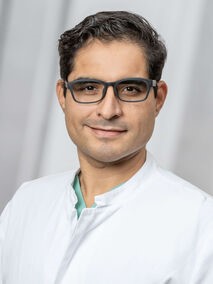
5 Questions with Arturo Olivares Rivera
Arturo Olivares Rivera, a clinical research physician at the Thoraxklinik (Working Group of DZL PI F. Trudzinsiki), is currently located in Birmingham UK for a clinical research rotation to advance his research into alpha-1 antitrypsin deficiency. He started his rotation on 1st of June and returns home at the end of July.
1. What does your current role involve?
I am a pulmonology resident at the Thoraxklinik in Heidelberg. I am also in charge of ThoraxKliPS, our center for clinical trials under the German Medicinal Products Act (AMG) in pulmonology. We perform studies on COPD, asthma, and interstitial lung diseases, among others. My tasks include organizing clinical trials with different sponsors. For our IITs, I collaborate with the PIs to write protocols. Once the site has been activated, I am responsible for screening patients for the trials, as well as their treatment throughout the trial. In the clinical setting, I assist my supervisor in the Alpha-1 Antitrypsin clinic.
2. Why did you choose to focus on Alpha-1 Antitrypsin Deficiency?
Initially, it was serendipitous, as my doctoral supervisor Prof. Franziska Trudzinski, offered me the opportunity to work with her on my thesis for my Dr. med. qualification. The project turned out to be very interesting scientifically and organisational, with collaborations beginning right away with the University of Hannover. We were also awarded a grant from the Alpha-1 Center in Germany to perform our prospective study. As is always the case in science, the more you read, the more questions you have, and the more interested you become in answering them. That's how AATD came to be the focus of my research.
3. What are you working on during your research rotation in Birmingham?
I am part of the EARCO (European Alpha-1 Research Collaboration) group. They offered a mobility opportunity for all Early Career Members (ECMs) to visit another Alpha-1 Center to observe their operations and to foster exchange. My supervisor here, Prof. Alice Turner, took it to the next level by organizing a clinical/research rotation, which I am very grateful about. In this rotation, I am mostly working on developing a systematic review of the diagnosis of AATD, which we will use as part of the ERS guidelines. I am especially thankful for having the opportunity to get involved with clinical work in the AATD and COPD clinics in NHS hospitals in Birmingham.
My special thanks go to the E&H Knorr Stiftung for their financial support in making this rotation possible.
4. How does research life in Birmingham compare with your work at the Thoraxklinik?
Compared to my usual day, the operative part is different during this rotation in the sense that I spend more time in the office working on the systematic review. However, Prof. Turner’s team ensured that I could work with patients at the clinics, which gave me the opportunity to observe the ATTD patients' approach in a different setting. For example, augmentation therapy is not reimbursed by health insurance here, so it is not used for all patients. There is also closer collaboration with the genetics and hepatology services when necessary. I learned what we do quite well back home and what other work practices and ideas I could bring back to try out. It is very enriching to see how other universities and health systems work.
5. Beyond the clinics: What's been the highlight of your time in Birmingham?
Had you ever heard of Birmingham before? I bet most people haven't. I am surprised about how vibrant, multicultural, open, green, and welcoming this city is. The people are nice and polite everywhere and at any time. The pub life during the World Cup was special. And the heat wave didn't hit as hard as it did in Germany.
July 15, 2026
Links:
https://www.birmingham.ac.uk/staff/profiles/applied-health/turner-alice